

Last updated: July 2026
Open ten Nepal trekking agency websites and you’ll notice something: they all look the same. Same stock photo of Everest at sunrise. Same “Best Price Guaranteed” banner. Same five-star testimonial carousel. Somewhere between planning your route and comparing prices, most trekkers realize the harder decision isn’t which trek to do — it’s who to trust with it.
Here’s what actually separates a good agency from a risky one, and what to check before you hand over a deposit.
Is It Actually Locally Owned and Operated?
This matters for more than ethics. A locally owned agency has real, working relationships with guides, teahouse owners, and permit offices — relationships built over years, not a franchise license bought last season. It also means more of what you pay stays inside Nepal’s economy, supporting the same communities your trek passes through.
It’s worth asking directly: who founded this company, and when? A company that’s been through multiple trekking seasons — good weather and bad, quiet years and busy ones — has been tested in ways a two-year-old operation hasn’t.
Are the Guides Actually Licensed?
“Our guide has 10 years of experience” sounds reassuring, but it isn’t the same as licensed. Nepal’s licensed guide credential involves formal training — first aid, altitude sickness response, and route-specific certification — administered through recognized bodies. As of 2023, a licensed guide is a legal requirement on most routes, not just a nice-to-have (see our Nepal Trekking Permits Guide for exactly where this applies).
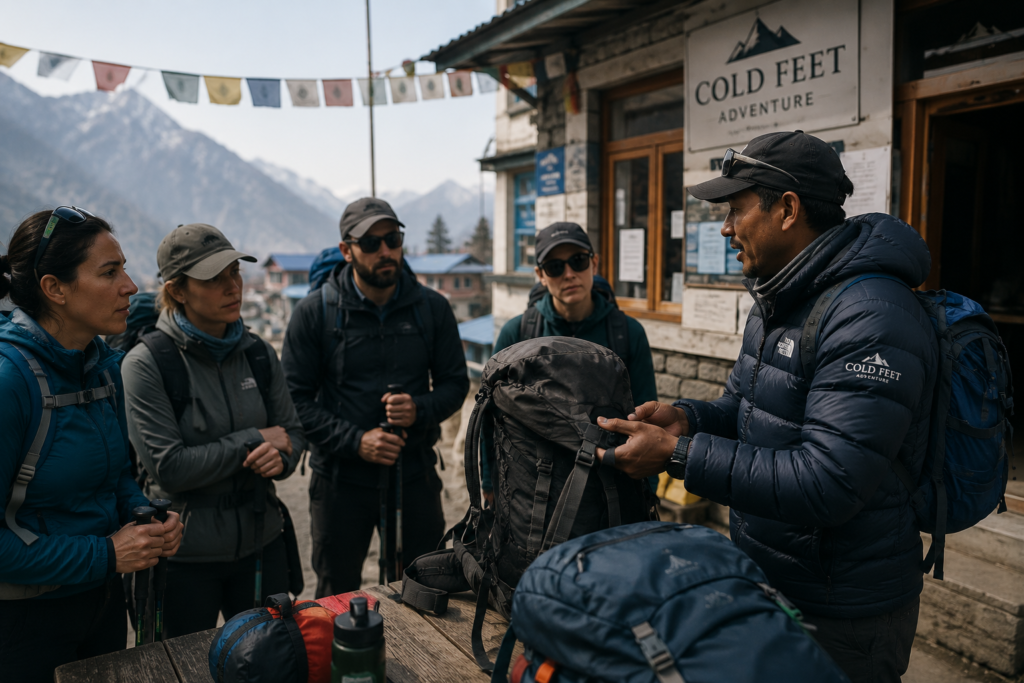
Ask an agency directly whether their guides hold current licenses, and whether guides receive ongoing training beyond the initial certification — first aid refreshers, updated rescue protocols, that sort of thing. A company that trains its staff year-round, not just once, tends to be the one that catches a problem before it becomes an emergency.
Do They Handle Permits In-House, or Outsource Them?
This is a small operational detail that says a lot. Agencies that outsource permit runs to a third party add a layer of delay — and a layer where mistakes can happen without anyone taking direct responsibility. Agencies that handle permits in-house tend to move faster, catch errors earlier, and know exactly where your paperwork stands at any point.
It’s a fair question to ask outright: “Do you process permits yourselves, or through another company?” A confident, specific answer is a good sign. A vague one isn’t.
What’s Actually Included in the Price?
The classic bait-and-switch: a low headline price, followed by a growing list of “extras” — permits, ground transport, gear rental, tips, sometimes even meals — that quietly bring the real cost close to (or above) a competitor’s honest quote.
As a rough benchmark, our own Nepal Trekking Cost Guide lists licensed guides at USD 30–45 per day and porters at USD 25–35 per day, inclusive of their food, accommodation, and insurance. If a quoted package price seems to leave little to no room for those numbers once permits and logistics are factored in, someone’s margin is coming from somewhere — usually an underpaid guide or an “extra” you haven’t been told about yet.
Red flag to watch for: If a price seems noticeably lower than everyone else’s for the same route and duration, ask exactly what’s excluded before you get excited about the savings. A transparent agency will list inclusions and exclusions clearly, without you having to dig for it.
For a full sense of what a trek should realistically cost, our Nepal Trekking Cost Guide breaks down every major expense category.
Group Size and Flexibility
Fixed departures with larger groups tend to be more budget-friendly but less flexible on pace — everyone moves together, on the same schedule. Smaller or private groups cost more but adapt to your fitness level, interests, and how many rest days you actually want.
If a company only offers fixed, non-negotiable departure dates with no private option, that’s worth knowing upfront — especially if your schedule has any flexibility at all. On the other hand, guaranteed fixed departures (dates that run regardless of minimum group size) solve a different problem: not getting stranded because “not enough people signed up.”
What Safety Protocols Should They Actually Have?
Ask specifically about:
- Emergency evacuation plans — what happens if someone needs to descend quickly or requires a helicopter evacuation?
- Communication on remote routes — satellite phones or radios where mobile coverage doesn’t reach.
- Guide-to-trekker ratio — a guide managing 15 people solo can’t give the same attention as one managing 6.
- Altitude sickness response — does the itinerary build in proper acclimatization days, and does the guide know the early warning signs?
An agency that checks and tests its own trails and routes regularly — rather than relying on outdated route notes — tends to catch changing trail conditions (washouts, bridge closures, rerouted paths) before they become a surprise mid-trek.
Reviews: What to Trust and What to Ignore
A wall of generic five-star reviews (“Amazing trip! Highly recommend!”) tells you almost nothing — those are easy to fake or incentivize. What’s worth reading closely: reviews that mention a guide by name, describe a specific problem that came up and how it was handled, or reference details only someone who actually went could know.
Recency matters too. A company with excellent reviews from five years ago and nothing recent may have changed — for better or worse. Look for a steady stream of detailed reviews across recent seasons, not just a cluster from one good year.
Red Flags Checklist
We’ve had trekkers come to us after a near-miss with another operator — one told us he’d nearly booked an agency that quoted 30% below everyone else, only to discover through a review buried on page three of search results that the “guide” assigned to his group wasn’t licensed at all, just a friend of the office manager. He caught it in time. Not everyone does. These are the signals that tend to show up before it’s too late to change course:
- No physical office address, or one that can’t be verified
- Vague or evasive answers about guide licensing
- Prices dramatically below every other quote for the same itinerary
- No clear explanation of how permits are handled
- Heavy pressure to book immediately or lose a “special discount”
- No affiliation with recognized bodies like the Nepal Tourism Board, TAAN (Trekking Agencies’ Association of Nepal), or NMA (Nepal Mountaineering Association)
Questions to Ask Before You Book
The checklist above tells you what to watch for passively — this is what to ask outright. Copy this list and send it to any agency you’re considering; a good one will answer all of it clearly and without hesitation:
- Can you send me your tourism license/registration number?
- Will I know my guide’s name before I arrive, and can I see their license?
- What’s your emergency evacuation plan for this specific route?
- What happens if the group doesn’t fill — does this departure still run?
- Can I speak to a past client who did this exact trek?
Frequently Asked Questions
Is it cheaper to trek independently instead of through an agency?
Sometimes, on unrestricted routes — but most regions now require a licensed guide by regulation (see our [LINK: Nepal Trekking Permits Guide]), and restricted areas like Manaslu and Upper Mustang require an agency by law regardless of budget.
Do I need to book before arriving in Nepal?
Not always for standard routes, but restricted area permits need lead time to process, and peak-season teahouse space fills up fast — booking ahead removes a lot of last-minute stress.
How far in advance should I book?
For popular routes in peak season (autumn especially), 2–3 months ahead is a safe window. Restricted area treks often need more lead time due to permit processing.
Can I trust an agency that only exists online, with no local office?
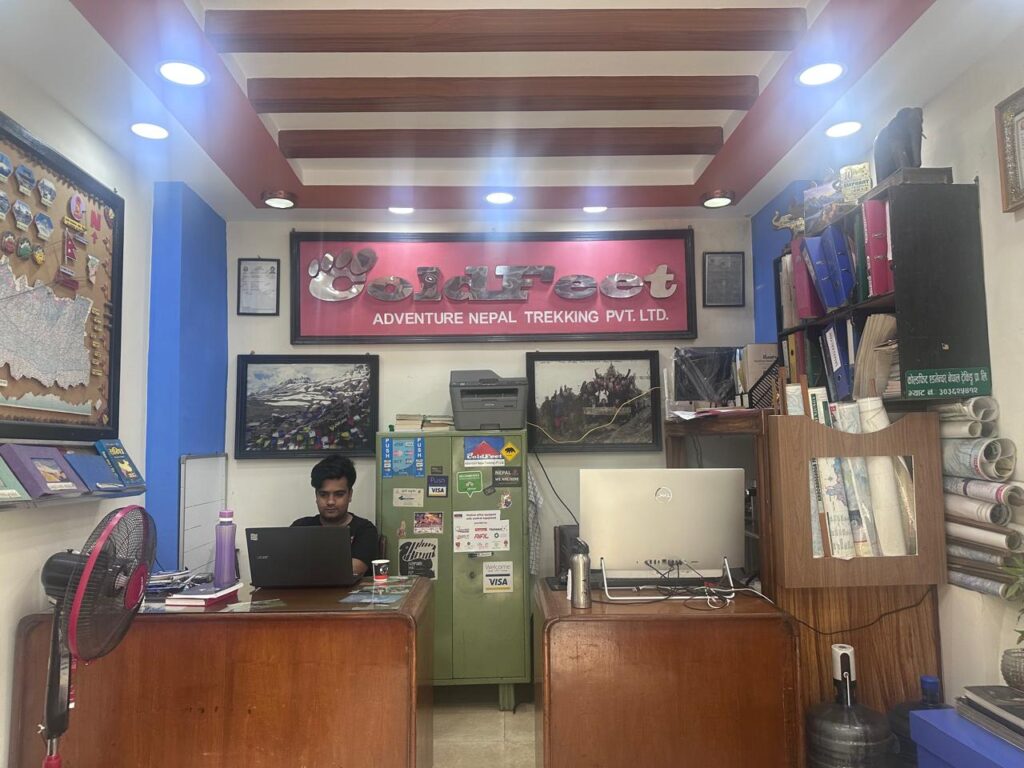
Be cautious. A verifiable physical office, direct phone line, and local affiliations (NTB, TAAN, NMA) are easy ways to confirm an agency is a real, accountable operation rather than a booking middleman.
Final Thoughts
The agency you choose isn’t just handling logistics — they’re who you’ll be sharing a teahouse table with at 4,000 meters, who’ll notice first if something’s wrong, and who’ll actually know what to do about it. That’s worth choosing as carefully as the trek itself, maybe more.
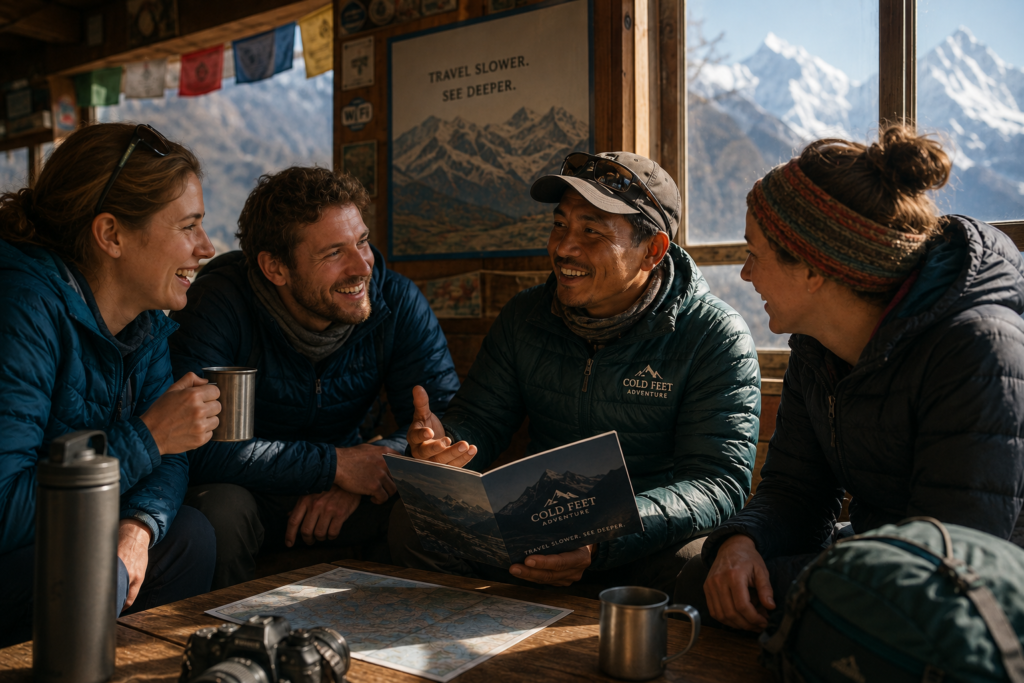
Why Trekkers Choose Cold Feet
We’ve been running treks out of Sat Ghumti, Thamel since 2009 — through good seasons and hard ones. Every guide is licensed and trained beyond the minimum, we handle permits in-house so nothing gets lost between offices, and our pricing has no hidden extras: what’s included is stated clearly, and what isn’t is stated just as clearly. We’re affiliated with the Nepal Tourism Board, TAAN, and NMA, and a share of what we earn goes back into local communities through the Cold Feet Foundation.
If you’d like to see how we work before you commit to anything, get in touch — we’re happy to answer every question on the list above, and then some.
Leave a Reply