

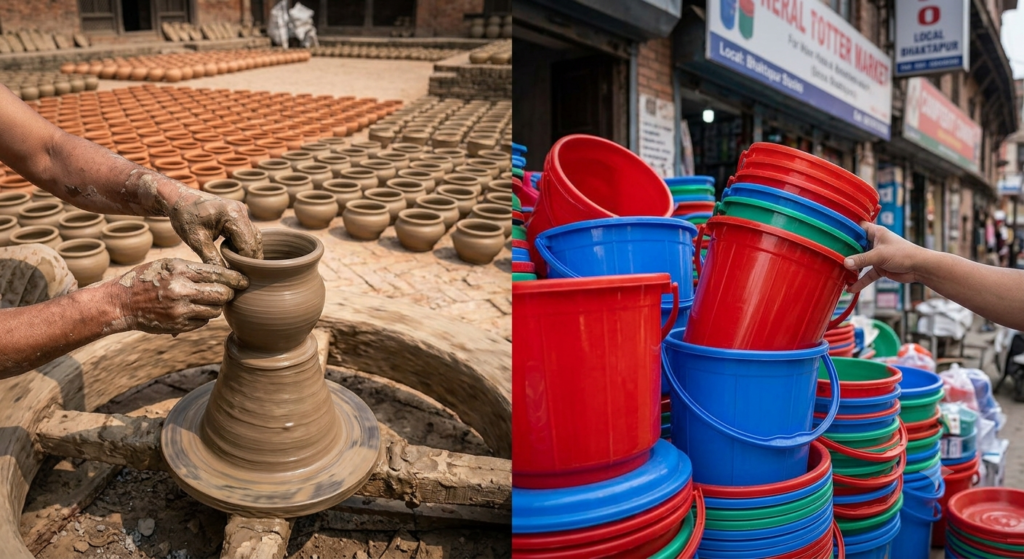
Walk south from Bhaktapur Durbar Square, down an alley near Taumadhi Tole, and the ground changes first. Rows of unglazed clay pots cover the pavement in a loose grid, set out to catch the sun. This isn’t a display. It’s a production line — wetting, spinning, drying, firing — laid out in the open because that’s what the process actually requires.
The square’s formal name is Bolachha Tole, though almost no one calls it that; everyone just says Pottery Square. It’s run by the Prajapati community, a Newar caste whose knowledge of clay and kiln management passes down through families rather than through any school. Even the clay itself is restricted: Prajapatis are permitted to dig it only once a year, from pits that go down 10 to 12 feet — hard, occasionally dangerous work that most visitors watching the finished pots never think about.
At the center of the square sits the two-roofed Jeth Ganesh temple, built in 1646 after a wealthy potter donated it. Around it, low rest-houses called pati, still used today for shade and conversation, line the drying areas. The Guthi system — the same inherited maintenance structure that keeps much of the valley’s older architecture standing — covers the upkeep of the square itself.
The part that isn’t picturesque
Of the roughly 226 households once engaged in pottery here, only around 60 still are. Cheap plastic goods have taken over most of the everyday market that clay pots used to fill — storage, cooking, water — leaving the craft increasingly dependent on tourism and decorative or festival-driven demand (clay lamps for Tihar, in particular) rather than daily household use. Some of the buildings around the square were also damaged in the 2015 earthquake; the square itself kept working through it.
If you go
Pottery Square costs nothing extra beyond Bhaktapur’s standard heritage entry fee. Most visitors spend 30 minutes to an hour; if you want to actually sit at a wheel, several potters offer a hands-on session — usually Rs. 100–150 — where you shape your own small cup or bowl in about five to ten minutes, guided by hand. Stay out of the central drying area itself; the pots there are mid-process, not props. Buying directly from a potter, rather than a shop reselling their work, is the most direct way your visit supports the people actually doing the work.
Are you interested in learning more about the artisans behind these crafts? Explore our curated artisan encounters to connect with master potters in Bhaktapur for a structured introduction to their work.
Leave a Reply